Go 1.26's Source-Level Inliner: A Game-Changer for Code Modernization
Introduction
The Go programming language continues to evolve with each release, and Go 1.26 brings a significant enhancement to the go fix subcommand. This tool has been completely reimplemented to help developers keep their codebases up-to-date with the latest language features and best practices. Among its new capabilities is the source-level inliner, a powerful mechanism that enables automated, safe transformations of function calls directly in your source code. In this article, we'll explore what the source-level inliner is, how it works, and why it matters for Go developers.

What Is the Source-Level Inliner?
The source-level inliner is a tool that replaces a function call with a copy of the function's body, substituting the actual arguments for the formal parameters. While traditional compiler inlining does this transformation on an ephemeral intermediate representation (IR) to generate faster machine code, source-level inlining durably modifies the human-readable source files. This makes it an ideal building block for refactoring tools and automated code migrations.
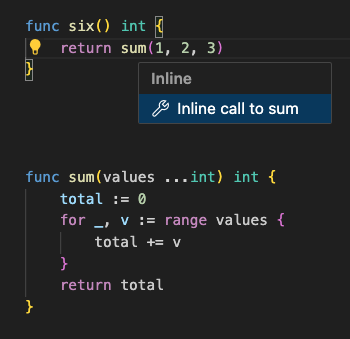
If you've ever used the "Inline call" refactoring offered by gopls, you've already experienced the power of the source-level inliner. For example, consider a call to a sum function:
func six() int {
    return sum(1, 2, 3)
}

func sum(a, b, c int) int {
    return a + b + c
}
After inlining the call to sum within six, the code becomes:
func six() int {
    a, b, c := 1, 2, 3
    return a + b + c
}
This simple transformation handles many subtle correctness issues automatically, such as name collisions, order of evaluation, and side effects. The inliner ensures that the resulting code behaves exactly like the original.
The New go fix Subcommand
Starting with Go 1.26, the go fix command has been rebuilt from the ground up. It now serves as a unified platform for applying code modernizations, including both built-in analyzers for specific language features and self-service modernizers that package authors can define. The source-level inliner is one of the key analyzers in this new go fix.
Self-Service Modernizers
One of the most exciting aspects of the new go fix is that it empowers any package author to express simple API migrations and updates in a straightforward and safe way. By leveraging the source-level inliner, you can define transformations that replace calls to deprecated functions with their modern equivalents, or adjust code to match new patterns. The inliner takes care of the complex details—such as handling variadic arguments, blank identifiers, and function literals—so you can focus on the semantics of the migration.
For instance, if you have a library function oldFunc that should be replaced by newFunc with a slightly different signature, you can write a refactoring rule that tells the inliner how to map arguments. The tool will then apply this rule across your entire project or module.
Technical Depth: How the Source-Level Inliner Works
The source-level inliner is not a simple text substitution. It operates on the Go abstract syntax tree (AST) and must respect the complexities of the language. Some of the key challenges it addresses include:
- Name shadowing and scoping: When inlining, variables in the caller's scope might conflict with parameter names. The inliner renames variables as needed to avoid shadowing.
- Order of evaluation: Arguments to a function call are evaluated in a specific order, and the inliner preserves that order when inserting them into the body.
- Side effects and escaping: If the called function has deferred calls or uses recover, the inliner transforms the code to maintain correct behavior, often by moving the call into a closure.
- Variadic and blank parameters: Special handling is required for
...parameters and blank (_) identifiers.
The algorithm was first developed in 2023 and has since been used as a foundation for several gopls refactorings, such as "Change signature" and "Remove unused parameter". Its integration into go fix means that a much broader audience can now benefit from automated, correct-by-construction code transformations.
Why This Matters for Go Developers
Keeping Go code modern is essential for security, performance, and maintainability. However, manually updating thousands of function calls across a large codebase is error-prone and tedious. The source-level inliner, when combined with the new go fix, provides a reliable way to automate these updates. Package maintainers can ship migration rules alongside new API versions, and users can apply them with a single command.
Furthermore, the same infrastructure enables advanced analyzers that can detect patterns and suggest improvements, making the language ecosystem healthier and more consistent.
Conclusion
Go 1.26's new go fix subcommand, powered by the source-level inliner, marks a significant step forward in tooling for the Go language. By making it easy to automate common migration tasks and by enabling self-service modernizers, Go continues to prioritize developer productivity and code quality. Whether you are a library author or an application developer, you'll find these tools invaluable for keeping your Go codebase clean, efficient, and up-to-date.